
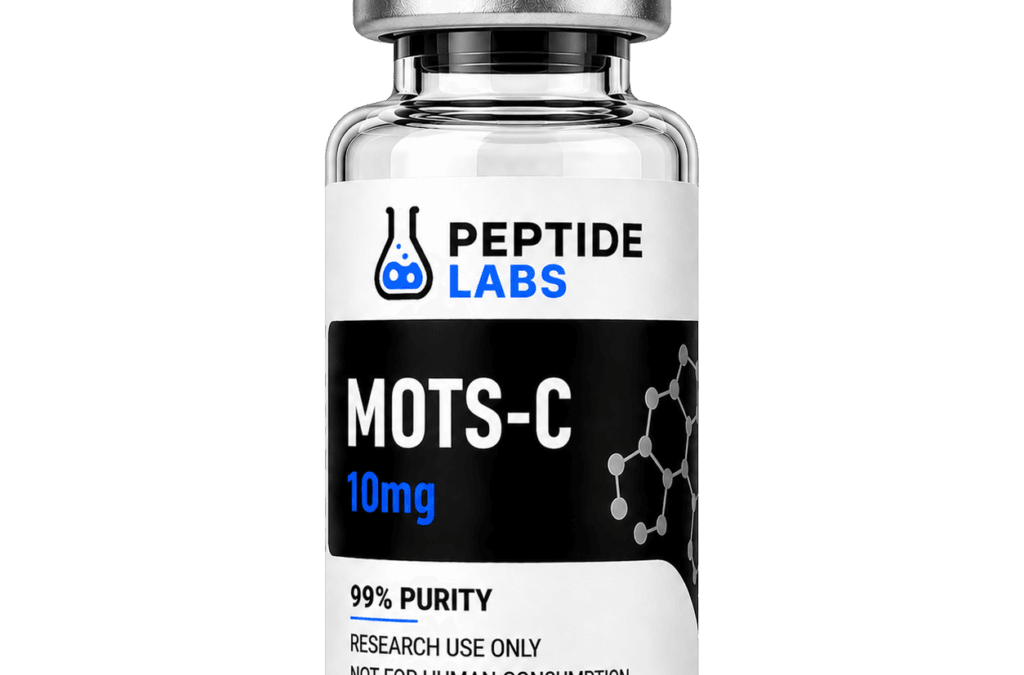
MOTS-C peptide has become an important subject within mitochondrial and cellular signalling research. Unlike many conventional peptides encoded within nuclear DNA, MOTS-C belongs to a group of mitochondrial-derived peptides that researchers are investigating to better understand communication between mitochondria and wider cellular systems.
Mitochondria are commonly associated with cellular energy production, but modern research has demonstrated that their biological role extends considerably beyond simply generating energy. They participate in metabolic signalling, cellular stress responses and numerous regulatory processes.
This makes MOTS-C peptide research particularly interesting for laboratories studying mitochondrial biology, cellular metabolism and molecular signalling.
For Peptide World Lab, MOTS-C also expands the research library beyond the peptide bioregulator cluster established around Cortagen, Chonluten, Vilon and Epithalamin and the GHRH-related content surrounding CJC-1295 and Mod GRF 1-29.
This guide examines what MOTS-C is, why researchers study it, mitochondrial-derived peptide research, experimental evidence, analytical testing, purity, storage and important considerations when sourcing laboratory materials.
Research Use Only: Peptide World Lab products are intended strictly for laboratory and scientific research. They are not intended for human consumption, self-administration, diagnosis, treatment or prevention of disease.
What Is MOTS-C Peptide?
MOTS-C peptide is a mitochondrial-derived peptide investigated in scientific research involving cellular metabolism, mitochondrial communication and stress-response pathways.
The name MOTS-C is derived from:
Mitochondrial Open Reading Frame of the 12S rRNA-c
Its mitochondrial origin makes the compound particularly interesting from a research perspective.
Scientists once viewed mitochondria primarily as structures responsible for cellular energy generation. Research over time has revealed that mitochondria participate in much broader biological communication.
Mitochondrial-derived peptides such as MOTS-C provide researchers with another way to investigate these complex signalling systems.
Potential research areas include:
- Mitochondrial signalling
- Cellular metabolism
- Metabolic regulation
- Cellular stress responses
- Molecular communication
- Energy-related pathways
- Cellular adaptation
- Age-related experimental models
Each research area requires careful experimental interpretation.
What Is a Mitochondrial-Derived Peptide?
A mitochondrial-derived peptide is a peptide associated with genetic information contained within mitochondrial DNA.
This distinguishes these peptides from many other research compounds.
Mitochondria contain their own genetic material, separate from most of the DNA stored within the cell nucleus.
Researchers studying mitochondrial-derived peptides may investigate how these molecules participate in communication between mitochondria and other cellular systems.
Examples of research questions include:
- How do mitochondrial signals influence cellular behaviour?
- How do cells respond to metabolic stress?
- Can mitochondrial-derived peptides influence gene-expression pathways?
- How do mitochondrial and nuclear signalling systems communicate?
- Do these processes change under different experimental conditions?
MOTS-C peptide research forms part of this developing area of mitochondrial biology.
Why Are Researchers Studying MOTS-C?
Scientific interest in MOTS-C peptide is largely connected to its relationship with mitochondrial and metabolic signalling.
Researchers may investigate whether MOTS-C participates in processes involving:
- Cellular metabolism
- Energy regulation
- Cellular stress
- Molecular signalling
- Metabolic adaptation
- Mitochondrial communication
These areas are fundamental to biological research.
However, the existence of interesting experimental observations should not be converted automatically into claims about proven health or therapeutic effects.
Scientific interpretation requires evidence from appropriately designed studies.
MOTS-C and Mitochondrial Research
Mitochondria perform several essential cellular functions.
Although energy production is one of their best-known roles, mitochondrial systems are also associated with:
- Cellular signalling
- Stress responses
- Metabolism
- Apoptosis
- Redox processes
- Cellular adaptation
Researchers studying MOTS-C peptide research may examine whether this mitochondrial-derived peptide participates in signalling between these processes.
This area is sometimes described broadly as mitochondrial communication.
Understanding such communication may help researchers investigate how cells coordinate responses to changing environmental and metabolic conditions.
MOTS-C and Cellular Metabolism Research
One major area of MOTS-C research involves cellular metabolism.
Metabolism refers to the chemical processes through which biological systems obtain, transform and use energy and molecular building blocks.
Researchers may examine how MOTS-C peptide interacts with pathways associated with:
- Cellular energy balance
- Glucose-related metabolism
- Metabolic signalling
- Nutrient responses
- Cellular adaptation
- Mitochondrial activity
These experimental areas have generated considerable scientific interest.
However, laboratory findings involving metabolic pathways should not automatically be interpreted as evidence that MOTS-C can treat metabolic diseases.
MOTS-C and Cellular Stress Research
Cells regularly encounter changing environmental conditions.
Researchers use controlled experimental models to study how cells respond to different types of stress.
MOTS-C peptide research has attracted attention within this broader field because mitochondrial signalling is closely connected with cellular stress responses.
Scientists may investigate:
- Molecular stress pathways
- Cellular adaptation
- Mitochondrial responses
- Gene-expression changes
- Protein signalling
- Metabolic responses
The significance of an observed response depends heavily on the experimental model.
MOTS-C and Gene Expression Research
Another interesting area involves communication between mitochondrial processes and nuclear gene expression.
Most human genetic material is stored within the nucleus, while mitochondria contain a much smaller independent genome.
Researchers studying mitochondrial-derived peptides are interested in understanding how signalling between these systems occurs.
Laboratory investigation may measure:
- Changes in gene expression
- Protein activity
- Cellular signalling
- Metabolic markers
- Mitochondrial responses
Research in this field can provide important information about cellular regulation without necessarily establishing clinical applications.
MOTS-C Peptide Benefits – Understanding Research Claims
Searches for MOTS-C peptide benefits may lead to websites making strong claims involving metabolism, physical performance, ageing or other outcomes.
Researchers should treat these claims cautiously.
There is an important evidence hierarchy.
In Vitro Research
Cell-based experiments can reveal molecular mechanisms under controlled conditions.
They cannot automatically predict what will occur in an entire organism.
Animal Research
Animal models allow researchers to investigate biological interactions in more complex systems.
However, animal findings do not automatically translate to humans.
Human Research
Human research provides more directly relevant information, but study quality still depends on factors such as:
- Sample size
- Controls
- Study design
- Duration
- Statistical analysis
- Replication
Established Clinical Evidence
Established medical claims require substantially stronger evidence than preliminary laboratory observations.
Therefore, discussions about MOTS-C peptide should clearly distinguish scientific investigation from proven therapeutic benefit.
MOTS-C and Ageing Research
Mitochondrial biology is frequently investigated within ageing research because mitochondrial function can change across the lifespan.
This has contributed to interest in MOTS-C peptide research involving experimental ageing models.
Scientists may investigate:
- Mitochondrial signalling
- Cellular stress
- Metabolic regulation
- Cellular adaptation
- Age-associated molecular changes
However, research involving ageing pathways does not mean MOTS-C has been proven to reverse ageing or extend human lifespan.
Those would be much stronger claims requiring robust clinical evidence.
MOTS-C and Exercise Research
MOTS-C has also appeared in scientific discussions involving metabolism and exercise-related biological responses.
Researchers studying this area may examine changes in:
- Metabolic signalling
- Cellular energy pathways
- Stress-response pathways
- Mitochondrial activity
- Molecular adaptation
These studies may improve scientific understanding of how cellular systems respond to physiological stress.
They should not automatically be interpreted as evidence supporting performance-enhancement claims.
How to Evaluate MOTS-C Research
Researchers interested in MOTS-C peptide should evaluate scientific studies systematically.
1. Identify the Experimental Model
Determine whether the study involved:
- Cells
- Tissues
- Animals
- Humans
- Computational models
This determines how broadly the findings can reasonably be interpreted.
2. Examine the Research Question
What exactly were the researchers attempting to measure?
Avoid drawing conclusions beyond the original study objective.
3. Review the Controls
Appropriate control groups improve confidence that an observed effect relates to the experimental variable.
4. Examine Sample Size
Small studies may provide useful preliminary findings without establishing definitive conclusions.
5. Review Statistical Analysis
Researchers should determine whether observed differences were statistically meaningful.
6. Read the Study Limitations
Limitations help explain what conclusions can and cannot reasonably be drawn.
7. Look for Independent Replication
Repeated findings from independent research groups generally provide stronger evidence than isolated observations.
MOTS-C vs Peptide Bioregulators
MOTS-C is quite different from the short peptide bioregulators covered in previous Peptide World Lab guides.
These include:
- Cortagen
- Chonluten
- Vilon
- Epithalamin
Although all can broadly appear within peptide research catalogues, they should not be grouped together scientifically simply because they are peptides.
Researchers comparing them should consider:
- Molecular origin
- Amino-acid sequence
- Molecular structure
- Research history
- Investigated pathways
- Experimental models
- Analytical characteristics
Our Vilon Peptide Bioregulator Research Guide and Epithalamin Peptide Research Guide provide more information about the bioregulator side of the research library.
MOTS-C vs ARA-290
ARA-290 peptide is another compound covered in our research library, but its research background differs substantially from MOTS-C.
ARA-290 has been investigated in research involving particular signalling and tissue-response mechanisms.
MOTS-C is primarily notable because of its mitochondrial origin and the research surrounding mitochondrial and metabolic signalling.
Researchers should therefore examine each compound independently rather than assuming research findings can be transferred between them.
Read our ARA-290 Peptide – Research and Laboratory Guide for a more detailed introduction to ARA-290.
MOTS-C vs CJC-1295
MOTS-C also differs significantly from CJC-1295.
CJC-1295 and Mod GRF 1-29 are associated with research involving growth hormone-releasing hormone-related signalling.
MOTS-C belongs to a completely different research area involving mitochondrial-derived peptide biology.
Our CJC-1295 No DAC Mod GRF 1-29 Research Guide and Mod GRF 1-29 vs CJC-1295 Comparison explain those compounds in greater detail.
These distinctions help researchers navigate different categories of peptide research.
Why MOTS-C Peptide Purity Matters
Product quality can influence experimental reliability.
When studying MOTS-C peptide, researchers should have confidence that the material corresponds to the intended compound.
Unexpected impurities may introduce additional experimental variables.
Important quality factors include:
- Compound identity
- Purity
- Batch information
- Analytical testing
- Storage requirements
- Packaging
- Research-use classification
A high purity claim should be evaluated together with supporting analytical documentation.
MOTS-C Peptide Testing
Researchers sourcing an MOTS-C research peptide may encounter several types of analytical documentation.
These can include:
- HPLC results
- Mass spectrometry
- Certificate of Analysis
- Batch documentation
- Purity information
Understanding the purpose of each test is important.
HPLC Testing for MOTS-C
High-performance liquid chromatography is commonly used for peptide analysis.
Depending on the analytical method, HPLC may provide information about:
- Sample composition
- Component separation
- Relative purity
- Additional peaks
An HPLC report can therefore be useful when evaluating a laboratory peptide.
However, researchers should avoid assuming that an HPLC purity percentage alone proves complete molecular identity.
Mass Spectrometry and MOTS-C
Mass spectrometry can provide information concerning molecular mass and may contribute to compound identification.
For MOTS-C peptide research, complementary analytical documentation can provide stronger characterization than relying on a single purity number.
Researchers should evaluate documentation according to the needs of their experiment.
Certificate of Analysis for MOTS-C
A Certificate of Analysis, or COA, may summarize product testing and batch information.
A useful COA may include:
- Product name
- Batch or lot number
- Testing date
- Purity result
- Analytical method
- Molecular information
- Laboratory details
- Storage guidance
Where possible, researchers should confirm that the COA corresponds to the actual batch being supplied.
MOTS-C Storage and Laboratory Handling
Correct storage is important for laboratory research materials.
Researchers should follow the storage instructions associated with the specific product.
Factors that may influence peptide stability include:
- Temperature
- Light exposure
- Moisture
- Storage duration
- Packaging
- Contamination
- Repeated environmental changes
Consistent laboratory handling can improve experimental reproducibility.
Choosing a MOTS-C Research Peptide Supplier
Researchers looking for MOTS-C peptide should evaluate suppliers using several criteria.
Clear Compound Identity
The product should clearly identify the research material.
Analytical Documentation
Available testing information can help researchers evaluate product characterization.
Purity Information
Researchers should understand how advertised purity was determined.
Batch Traceability
Batch information can help laboratories maintain accurate research records.
Research-Use Labelling
The product should clearly state its intended laboratory classification.
Storage Information
Appropriate storage guidance should be available.
Transparent Policies
Shipping, returns, privacy, terms and customer-support information should be easy to locate.
Research Peptides USA and MOTS-C
Researchers searching for research peptides USA can encounter a large number of suppliers.
The cheapest option is not necessarily the most suitable laboratory material.
Before sourcing MOTS-C or another peptide, consider:
- Product identity
- Purity
- Testing
- Batch documentation
- Research-use labelling
- Storage information
- Shipping policies
- Secure checkout
- Customer support
- Supplier transparency
These factors can be especially important when experimental reproducibility matters.
Finding Reliable MOTS-C Research
Researchers should use independent scientific databases alongside supplier information.
The National Library of Medicine provides access to biomedical research resources, including PubMed.
When evaluating MOTS-C studies, examine:
- Authors
- Publication date
- Journal
- Experimental model
- Methods
- Sample size
- Controls
- Statistical analysis
- Results
- Limitations
- References
Original scientific publications provide much more context than promotional summaries.
Research Use Only
MOTS-C and other products discussed by Peptide World Lab are intended strictly for laboratory and scientific research.
They are not intended for:
- Human consumption
- Self-administration
- Medical treatment
- Diagnosis
- Disease prevention
- Therapeutic use
Nothing in this guide should be interpreted as medical advice or human-use instructions.
Related Links:
👉 CJC-1295 No DAC Mod GRF 1-29 – Research Guide
👉 Chonluten Peptide Research – Bioregulator Study Guide
👉 Chonluten Peptide – Research and Bioregulator Guide
👉 Cortagen Peptide Research – Bioregulator Study Guide
👉 Cortagen Peptide – Research and Laboratory Guide
👉Mod GRF 1-29 vs CJC-1295 – Research Comparison Guide
👉ARA-290 Peptide – Research and Laboratory Guide
👉 MOTS-C Peptide – Research and Laboratory Guide
👉Epithalamin Peptide – Research and Bioregulator Guide
👉Vilon Peptide Bioregulator – Research Guide
Final Thoughts
MOTS-C peptide represents an interesting research area at the intersection of mitochondrial biology, cellular metabolism and molecular signalling.
Its mitochondrial origin distinguishes it from many of the research peptides covered in our previous guides.
Scientists investigating MOTS-C may examine mitochondrial communication, metabolic signalling, cellular stress responses, gene-expression mechanisms and other molecular processes. These experimental findings can improve understanding of mitochondrial biology, but they should not automatically be interpreted as established therapeutic benefits.
Researchers sourcing an MOTS-C research peptide should also consider product identity, purity, analytical documentation, batch traceability, storage conditions and supplier transparency.
Frequently Asked Questions
1. What is MOTS-C peptide?
MOTS-C is a mitochondrial-derived peptide investigated in scientific research involving mitochondrial signalling, cellular metabolism and other molecular regulatory processes.
2. What does MOTS-C stand for?
MOTS-C refers to Mitochondrial Open Reading Frame of the 12S rRNA-c, reflecting its association with mitochondrial genetic information.
3. What is MOTS-C peptide research focused on?
Research has investigated mitochondrial signalling, cellular metabolism, stress-response pathways and related molecular processes. Findings should be interpreted according to the experimental model and quality of evidence.
4. Why is MOTS-C peptide purity important?
Purity and compound identity can affect experimental reliability. Researchers should evaluate analytical testing, batch documentation and product characterization when selecting laboratory materials.
5. Where can researchers find MOTS-C peptide?
Researchers can source MOTS-C from specialist research-product suppliers. Compound identity, purity information, analytical documentation, research-use labelling, storage information and supplier policies should be reviewed before purchasing.