Mod GRF 1-29 vs CJC-1295 is an important comparison for researchers exploring growth hormone-releasing hormone analogues and related peptide signalling compounds. The terminology surrounding these research peptides can be confusing because CJC-1295, CJC-1295 No DAC, CJC-1295 with DAC, and Modified GRF 1-29 are sometimes discussed together despite important structural and research distinctions.
This comparison is particularly relevant because searches involving Mod GRF 1-29 vs CJC-1295, CJC-1295 No DAC, modified GRF and ModGRF are already associated with Peptide World Lab in organic search.
Understanding the terminology is important before selecting materials for laboratory research. Researchers should examine the precise compound identity, molecular characteristics, analytical documentation and experimental objectives rather than relying exclusively on the name displayed on a supplier’s product page.
This guide explains the main differences researchers should understand when comparing Mod GRF 1-29 vs CJC-1295.
What Is Mod GRF 1-29?
Mod GRF 1-29, also commonly written as Modified GRF 1-29 or ModGRF, is a modified peptide associated with growth hormone-releasing hormone research.
Researchers may investigate this type of compound in controlled laboratory models involving peptide-receptor interactions, signalling mechanisms and structure-function relationships.
Research involving Modified GRF 1-29 may examine areas such as:
- Peptide signalling
- Receptor interactions
- Molecular stability
- Structure-function relationships
- Experimental kinetics
- Endocrine signalling pathways
- Peptide degradation
- Biological response models
The purpose of any experiment depends on the research question and experimental design.
What Is CJC-1295?
CJC-1295 is another peptide associated with research involving growth hormone-releasing hormone pathways.
However, one of the biggest sources of confusion when comparing Mod GRF 1-29 vs CJC-1295 is that the name CJC-1295 is sometimes used loosely across commercial peptide websites.
Researchers may encounter:
- CJC-1295
- CJC-1295 with DAC
- CJC-1295 No DAC
- CJC-1295 w/o DAC
- Modified GRF 1-29
- Mod GRF 1-29
These names should not automatically be treated as describing identical research materials.
Researchers should verify the exact compound being supplied.
Mod GRF 1-29 vs CJC-1295: What’s the Difference?
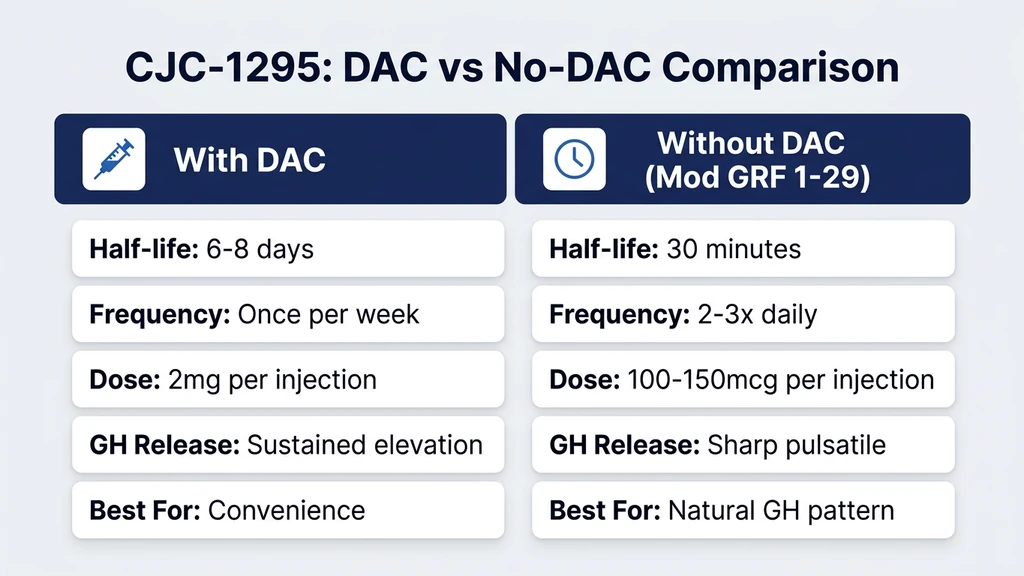
The most important difference in a Mod GRF 1-29 vs CJC-1295 comparison involves molecular modification and the presence or absence of the Drug Affinity Complex, commonly abbreviated as DAC.
Mod GRF 1-29
Modified GRF 1-29 is generally discussed as a modified GHRH-related peptide without the DAC modification.
Its characteristics make it a subject of laboratory research involving comparatively shorter-duration peptide signalling models.
CJC-1295 With DAC
CJC-1295 with DAC incorporates a modification designed to alter certain molecular characteristics, including biological persistence.
This can make it relevant to research models involving different exposure characteristics.
Because of this structural difference, researchers should not treat the two compounds as interchangeable.
What Is CJC-1295 No DAC?
This is where the terminology becomes particularly confusing.
The phrase CJC-1295 No DAC is widely used by research peptide suppliers to describe products closely associated with Modified GRF 1-29 terminology.
Researchers may therefore encounter product names such as:
CJC-1295 No DAC (Mod GRF 1-29)
or:
CJC-1295 w/o DAC / Modified GRF 1-29
This does not mean researchers should rely on the label alone.
Compound identity should be confirmed through available product specifications and analytical documentation.
Why Does DAC Matter in CJC-1295 Research?
DAC stands for Drug Affinity Complex.
The presence of this modification is an important distinction when evaluating Mod GRF 1-29 vs CJC-1295.
A molecular modification can alter properties such as:
- Stability
- Binding characteristics
- Experimental persistence
- Peptide kinetics
- Research protocol requirements
Therefore, CJC-1295 with DAC and a research material described as CJC-1295 No DAC should not automatically be used interchangeably within an experiment.
Researchers should design experiments according to the exact compound being studied.
Mod GRF 1-29 vs CJC-1295 Comparison
The following provides a simple research-focused comparison:
| Research Factor | Mod GRF 1-29 | CJC-1295 With DAC |
|---|---|---|
| GHRH-related research | Yes | Yes |
| Modified peptide | Yes | Yes |
| DAC modification | No | Yes |
| Research kinetics | Comparatively shorter model | Longer-persistence research model |
| Compound verification needed | Yes | Yes |
| Research use only | Yes | Yes |
This table provides a general overview rather than a substitute for compound-specific analytical documentation.
Modified GRF 1-29 Terminology Explained
Researchers searching online may encounter several variations of the same terminology.
These include:
- Modified GRF
- Modified GRF 1-29
- Mod GRF
- Mod GRF 1-29
- ModGRF
- CJC-1295 No DAC
Rather than creating separate articles for every variation, these related searches can be covered naturally within one comprehensive resource.
This helps researchers understand the terminology while giving search engines clearer context around the topic.
Why Researchers Compare Mod GRF 1-29 and CJC-1295
Researchers may compare these compounds when designing experiments involving peptide signalling.
A comparison may consider:
- Molecular structure
- Modifications
- Stability
- Receptor interaction
- Experimental persistence
- Analytical characteristics
- Existing scientific literature
The correct research material depends on the scientific question being investigated.
There is no scientifically meaningful reason to label one peptide universally “better” than another without defining the research objective.
Research Applications of Mod GRF 1-29
Laboratory research involving Mod GRF 1-29 may explore molecular processes associated with GHRH-related signalling.
Experimental areas can include:
- Receptor binding
- Cellular signalling
- Peptide stability
- Molecular degradation
- Structure-function relationships
- Endocrine pathway models
- Experimental kinetics
These research areas should not be interpreted as established therapeutic applications.
Research Applications of CJC-1295
CJC-1295 research may similarly involve experimental investigation of peptide signalling and molecular behaviour.
Researchers may examine:
- Molecular interactions
- Receptor mechanisms
- Peptide persistence
- Signalling pathways
- Structural modifications
- Experimental biological responses
The presence of DAC is especially important when interpreting studies involving CJC-1295.
Researchers should determine precisely which version of the peptide was used before comparing results across studies.
How to Read CJC-1295 Research Correctly
Not all online information discussing CJC-1295 provides enough detail to identify the exact compound studied.
When reviewing scientific research, look for:
Exact Compound Name
Determine whether the paper refers to CJC-1295 with DAC, another CJC analogue or a modified GHRH-related sequence.
Molecular Information
Where available, examine the compound structure or sequence.
Experimental Model
Was the research conducted using cells, tissues, animals or human participants?
Study Design
Look for appropriate controls and clearly defined experimental procedures.
Limitations
Researchers should consider the limitations identified by the authors before generalizing findings.
Why Peptide Identity Matters
Product identity is especially important in a Mod GRF 1-29 vs CJC-1295 comparison because naming conventions can vary.
If a laboratory believes it is studying one compound but receives another, the entire experiment may be compromised.
Researchers should therefore examine:
- Product specifications
- Molecular information
- Batch documentation
- Analytical testing
- Certificate of Analysis
- Supplier labelling
Accurate identification supports better experimental reproducibility.
Why Purity Matters
Peptide purity can influence laboratory results.
Unexpected impurities may introduce additional variables into an experiment, making it more difficult to determine whether an observed response resulted from the intended peptide.
Researchers evaluating Mod GRF or CJC-1295 research materials should consider:
- Stated purity
- Testing method
- Batch information
- Product identity
- Storage conditions
- Analytical documentation
A high advertised purity percentage should not be the only criterion used to judge research material.
HPLC Testing
High-performance liquid chromatography, or HPLC, is frequently used in peptide analysis.
Depending on the analytical method, HPLC may provide information about:
- Sample composition
- Component separation
- Purity
- Additional peaks
However, researchers should understand what the analysis actually establishes.
HPLC purity information by itself may not provide complete molecular identification.
Mass Spectrometry
Mass spectrometry can provide information regarding molecular mass and can contribute to peptide identification.
For researchers comparing Mod GRF 1-29 vs CJC-1295, analytical methods that help verify compound identity can be particularly valuable because of the confusing commercial terminology surrounding these peptides.
Certificate of Analysis
A Certificate of Analysis may contain:
- Product name
- Batch number
- Testing date
- Purity information
- Analytical method
- Laboratory information
- Product specifications
Where possible, researchers should verify that the documentation corresponds to the actual batch being supplied.
Storage and Laboratory Handling
Peptide stability can be influenced by environmental conditions.
Researchers should follow product-specific storage instructions and established laboratory protocols.
Important considerations can include:
- Temperature
- Light exposure
- Moisture
- Packaging
- Storage duration
- Contamination prevention
Correct handling supports better experimental consistency.
Mod GRF 1-29 vs CJC-1295 Research Evidence
When comparing scientific literature, researchers should avoid looking only at reported outcomes.
Study quality matters.
Consider:
- Experimental model
- Sample size
- Controls
- Research methodology
- Statistical analysis
- Independent replication
- Study limitations
A laboratory observation does not automatically establish a human therapeutic benefit.
This distinction is especially important for peptide compounds frequently discussed outside formal scientific settings.
CJC-1295 and Research Peptides USA
Researchers searching for research peptides USA should carefully evaluate suppliers offering CJC-1295 or Modified GRF products.
A professional supplier should provide clear information about:
- Product identity
- Research classification
- Purity
- Testing
- Batch information
- Storage
- Shipping
- Customer support
- Return policies
The Peptide World Lab Store provides access to available laboratory research products and individual product information.
Buying Mod GRF 1-29 or CJC-1295 for Research
Searches such as buy CJC-1295 No DAC Mod GRF 1-29 show clear commercial intent.
We should use that intent strategically.
This comparison article should target informational queries such as:
- Mod GRF 1-29 vs CJC-1295
- CJC-1295 vs Mod GRF
- Modified GRF
- CJC-1295 No DAC difference
The relevant product page should target:
- Buy CJC-1295 No DAC
- Buy Mod GRF 1-29
- CJC-1295 No DAC for sale
- Mod GRF 1-29 for sale
This separation helps prevent the blog from competing directly against the product page.
Finding Reliable Peptide Research
Researchers should supplement supplier information with independent scientific resources.
The National Library of Medicine provides access to biomedical research databases and resources, including PubMed.
When evaluating scientific literature, examine the original research methodology and conclusions rather than relying exclusively on commercial summaries.
Research Use Only
All products discussed by Peptide World Lab are intended strictly for laboratory and scientific research.
They are not intended for:
- Human consumption
- Self-administration
- Medical treatment
- Diagnosis
- Disease prevention
- Therapeutic use
Educational content on this website should not be interpreted as medical advice.
Related Links:
👉 CJC-1295 No DAC Mod GRF 1-29 – Research Guide
👉 Chonluten Peptide Research – Bioregulator Study Guide
👉 Chonluten Peptide – Research and Bioregulator Guide
👉 Cortagen Peptide Research – Bioregulator Study Guide
👉 Cortagen Peptide – Research and Laboratory Guide
👉Mod GRF 1-29 vs CJC-1295 – Research Comparison Guide
👉ARA-290 Peptide – Research and Laboratory Guide
👉 MOTS-C Peptide – Research and Laboratory Guide
👉Epithalamin Peptide – Research and Bioregulator Guide
👉Vilon Peptide Bioregulator – Research Guide
Final Thoughts
Understanding Mod GRF 1-29 vs CJC-1295 requires more than comparing two product names.
Researchers need to consider the exact compound identity, molecular modifications, presence or absence of DAC, experimental design and analytical documentation.
The distinction becomes particularly important because terms such as CJC-1295 No DAC, CJC-1295 w/o DAC, Modified GRF 1-29 and ModGRF are sometimes used inconsistently across commercial sources.
Researchers should therefore verify the actual research material rather than relying solely on naming conventions.
while connecting the CJC-1295 cluster with the existing Cortagen and Chonluten research resources.
Frequently Asked Questions
1. What is the difference between Mod GRF 1-29 and CJC-1295?
The terminology can vary, but an important distinction involves molecular modifications and the presence or absence of DAC. Researchers should verify the exact compound identity rather than relying only on product names.
2. Is CJC-1295 No DAC the same as Mod GRF 1-29?
The terms are often used in overlapping ways by peptide suppliers. Researchers should check the actual amino-acid sequence, molecular specifications and analytical documentation to confirm product identity.
3. What does DAC mean in CJC-1295?
DAC stands for Drug Affinity Complex. Its presence changes molecular characteristics relevant to experimental persistence and other research parameters.
4. Why does purity matter when comparing these peptides?
Impurities may introduce unwanted experimental variables. Researchers should examine purity, identity, batch information and analytical documentation when selecting laboratory materials.
5. Which is better, Mod GRF 1-29 or CJC-1295?
There is no universally “better” research peptide. The appropriate compound depends on the experimental question, required molecular characteristics and research design.