
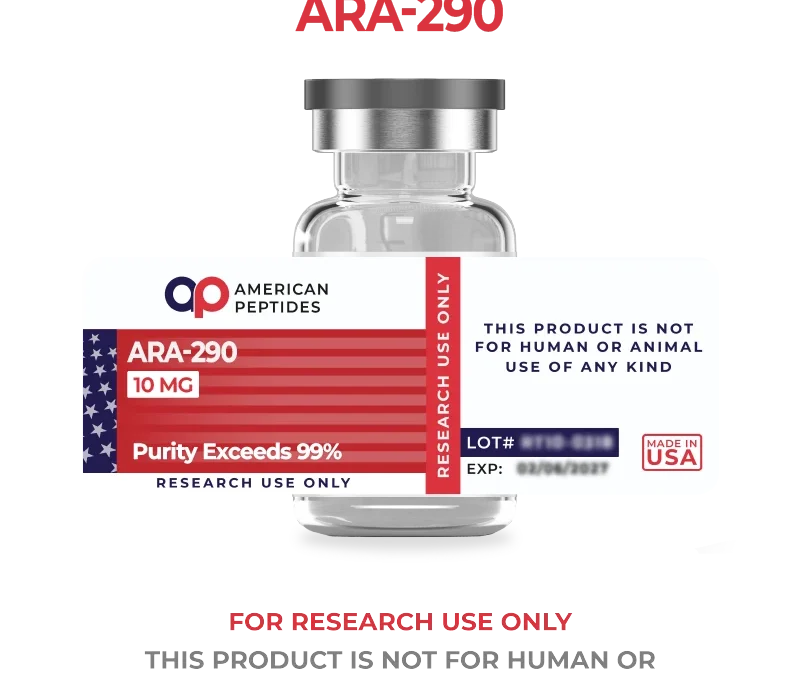
ARA-290 peptide has attracted scientific interest as researchers continue to investigate peptide-based compounds, molecular signalling pathways and cellular responses under controlled laboratory conditions.
ARA-290 differs considerably from the short peptide bioregulators covered in our previous Cortagen and Chonluten guides. Understanding those differences is important when evaluating research literature, laboratory applications and analytical documentation.
Interest in ARA-290 is particularly relevant to Peptide World Lab because the website has already begun appearing in Google Search Console for ARA-290-related searches. Building a comprehensive educational resource around the compound can help researchers find more useful information while strengthening the site’s growing research peptide library.
This guide examines ARA-290 peptide research, scientific background, experimental evidence, product quality, analytical testing, storage and important considerations when sourcing peptides for laboratory investigation.
Research Use Only: Products discussed by Peptide World Lab are intended strictly for laboratory and scientific research purposes. They are not intended for human consumption, self-administration, diagnosis, treatment or prevention of disease.
What Is ARA-290 Peptide?
ARA-290 peptide is a synthetic peptide that has been investigated in scientific research involving cellular signalling and tissue-response pathways.
It has also appeared in scientific literature under the name cibinetide, particularly in research examining its molecular and biological characteristics.
ARA-290 was developed from research involving erythropoietin-related biological pathways, but it is structurally distinct from the full erythropoietin molecule.
This distinction is important.
Researchers should not assume that two compounds have identical biological characteristics simply because one was developed from research involving another molecule.
Studies involving ARA-290 peptide research may investigate areas such as:
- Molecular signalling
- Cellular responses
- Receptor interactions
- Tissue-response mechanisms
- Inflammatory signalling models
- Experimental cellular stress
- Structure-function relationships
- Peptide stability
Each area requires its own experimental design and scientific interpretation.
ARA-290 and Cibinetide
Researchers searching scientific databases may encounter the term cibinetide when looking for information about ARA-290.
This is useful to understand because scientific literature may not always use the same terminology found on research-product websites.
Searching both:
ARA-290
and
cibinetide
can therefore help researchers locate a broader range of relevant publications.
However, product identity should always be confirmed independently through the specifications and analytical documentation associated with the laboratory material being purchased.
A similar name is not a substitute for verified compound identity.
Why Is ARA-290 Studied?
Interest in ARA-290 peptide developed from research into signalling mechanisms associated with tissue responses and cellular regulation.
Researchers may investigate how the peptide interacts with particular receptor systems or molecular pathways under controlled experimental conditions.
Potential research questions include:
- How does ARA-290 interact with particular cellular pathways?
- What receptor mechanisms are involved?
- How does the compound behave under different experimental conditions?
- Are observed responses concentration-dependent?
- How stable is the peptide?
- Can findings be reproduced independently?
- How do different research models affect observed outcomes?
These questions demonstrate why peptide research requires careful experimental design.
Research should focus on measurable biological mechanisms rather than assumptions based on online marketing claims.
ARA-290 Peptide Research and Receptor Signalling
One important area of ARA-290 peptide research concerns receptor-mediated signalling.
Receptors are molecular structures capable of interacting with specific molecules and participating in cellular communication.
When scientists investigate a research peptide, they may examine whether the peptide:
- Interacts with particular receptor systems
- Influences downstream signalling
- Produces measurable cellular responses
- Changes molecular markers
- Behaves differently under altered experimental conditions
Such research helps scientists understand biological mechanisms.
It does not automatically establish that the same compound provides a therapeutic benefit in humans.
ARA-290 and Tissue-Response Research
ARA-290 has also attracted research attention involving tissue-response pathways.
Experimental studies in this area may investigate how cells or tissues respond under particular controlled conditions.
Researchers might measure:
- Cellular signalling changes
- Molecular markers
- Protein expression
- Gene-expression patterns
- Cellular stress responses
- Tissue-specific experimental responses
The significance of any observation depends on the research model.
For example, an observation in cultured cells cannot automatically establish what would happen in an intact human biological system.
ARA-290 and Inflammation Research
Another area associated with ARA-290 peptide research involves experimental inflammatory signalling.
Inflammation is a complex biological process involving numerous cells, signalling molecules and regulatory pathways.
Laboratory researchers may investigate whether a peptide interacts with particular pathways involved in experimental inflammatory models.
However, it is important to distinguish between:
studying an inflammatory pathway
and
demonstrating that a compound treats an inflammatory disease.
Those are not the same conclusion.
A laboratory observation can help researchers generate hypotheses that require additional testing.
ARA-290 Peptide Benefits – Interpreting Online Claims
People researching ARA-290 online may encounter searches or articles discussing ARA-290 peptide benefits.
This terminology should be treated carefully.
A research compound may produce interesting observations in:
- Cell studies
- Tissue experiments
- Animal models
- Molecular research
but these observations should not automatically be converted into proven human health benefits.
When evaluating claims about ARA-290 peptide, researchers should ask:
What Type of Study Was Conducted?
Was it laboratory, animal or human research?
How Large Was the Study?
Small experimental studies may provide preliminary evidence without establishing broad conclusions.
Was There a Control Group?
Appropriate controls strengthen experimental interpretation.
Were Results Replicated?
Independent replication increases confidence in scientific findings.
What Did the Authors Actually Conclude?
Researchers should distinguish the conclusions in the original paper from stronger claims made by third-party websites.
Understanding Preclinical ARA-290 Research
Preclinical research is an important stage of scientific investigation.
It can include:
- In vitro studies
- Animal models
- Molecular experiments
- Tissue models
Preclinical ARA-290 peptide research can help scientists understand mechanisms and determine whether additional investigation may be justified.
However, preclinical findings should not automatically be treated as clinical evidence.
This distinction is particularly important for research peptides because online descriptions sometimes omit the limitations of the original studies.
Understanding Human Research
Human research provides a different level of evidence from isolated laboratory models.
When evaluating any human research involving ARA-290 or related compounds, researchers should consider:
- Study design
- Number of participants
- Control groups
- Randomization
- Duration
- Outcomes measured
- Statistical analysis
- Study limitations
- Independent replication
Even a human study should not be summarized more strongly than its actual results justify.
How to Evaluate ARA-290 Research
Researchers investigating ARA-290 peptide should examine original scientific publications whenever possible.
A useful evaluation process includes:
1. Identify the Research Question
What were the researchers actually trying to determine?
2. Identify the Experimental Model
Was the experiment conducted using cells, animals, tissues or humans?
3. Review the Methods
The methods section explains how the experiment was conducted.
4. Examine the Results
Look at the actual measurements rather than relying only on the abstract.
5. Read the Limitations
Limitations provide important context for interpreting results.
6. Look for Replication
Find out whether independent research groups have produced similar observations.
This approach provides a much stronger understanding of ARA-290 peptide research than relying on commercial summaries.
Why ARA-290 Peptide Quality Matters
The quality of research materials can influence experimental reliability.
If researchers intend to study ARA-290 peptide, they need confidence that the material corresponds to the compound described in the experiment.
Important quality considerations include:
- Compound identity
- Purity information
- Batch identification
- Analytical documentation
- Packaging
- Storage information
- Research-use classification
- Supplier transparency
Poorly characterized materials can introduce additional uncertainty into experimental results.
ARA-290 Purity and Laboratory Research
Purity is an important factor when sourcing an ARA-290 research peptide.
Unexpected substances within a sample can potentially interfere with experimental measurements.
Researchers should therefore evaluate available purity information carefully.
However, a statement such as:
“99% purity”
should not automatically be treated as complete evidence of product quality.
Researchers should determine:
- How was purity measured?
- What analytical method was used?
- Is the documentation batch-specific?
- Does the report identify the compound?
- When was the analysis performed?
These questions provide more useful information than a purity percentage alone.
HPLC Testing for Research Peptides
High-performance liquid chromatography, or HPLC, is frequently used in peptide analysis.
Depending on the analytical procedure, HPLC can help researchers examine:
- Sample composition
- Component separation
- Purity
- Additional peaks
For an ARA-290 peptide product, HPLC documentation can provide useful analytical information.
However, HPLC purity should not automatically be interpreted as complete proof of molecular identity.
Mass Spectrometry and ARA-290
Mass spectrometry is another analytical method frequently used in peptide research.
It can provide information relating to molecular mass and may contribute to compound identification.
Researchers evaluating ARA-290 laboratory material may therefore look for complementary analytical documentation rather than relying on a single testing method.
This can improve confidence in product characterization.
Certificate of Analysis for ARA-290
A Certificate of Analysis, or COA, may summarize analytical information associated with a particular research material.
Depending on the supplier and laboratory, it may include:
- Product name
- Batch number
- Testing date
- Purity result
- Analytical method
- Molecular information
- Laboratory information
- Storage instructions
Where batch-specific documentation is available, researchers should confirm that it corresponds to the material being supplied.
ARA-290 Storage and Handling
Proper storage is important for preserving peptide research materials.
Researchers should follow the storage instructions supplied with the specific product rather than assuming every peptide should be handled identically.
Factors potentially affecting peptide stability include:
- Temperature
- Light
- Moisture
- Contamination
- Storage duration
- Repeated environmental changes
Proper documentation and consistent laboratory procedures help maintain research-material integrity.
ARA-290 vs Peptide Bioregulators
ARA-290 differs from some of the peptide bioregulators covered in our earlier research guides.
For example, Peptide World Lab has published resources covering:
- Cortagen
- Chonluten
These compounds have their own structures, research histories and investigated biological pathways.
ARA-290 should therefore not be grouped together with Cortagen or Chonluten simply because all are described as peptides.
A useful comparison requires researchers to consider:
- Amino-acid sequence
- Molecular structure
- Research history
- Receptor interactions
- Experimental models
- Analytical characteristics
Each compound deserves independent evaluation.
ARA-290 vs CJC-1295 Research
ARA-290 also differs substantially from CJC-1295 No DAC Mod GRF 1-29, which we examined in Blogs #5 and #6.
CJC-1295 and Mod GRF research is associated with GHRH-related signalling, while ARA-290 has a different research background and molecular focus.
Researchers should therefore avoid assuming that different peptides share similar experimental characteristics simply because they appear within the same research peptide catalogue.
This is why Peptide World Lab is creating compound-specific educational guides rather than one generic article covering every peptide.
Finding ARA-290 Research Online
Researchers should use independent scientific databases when investigating ARA-290.
The National Library of Medicine provides access to biomedical research resources, including PubMed.
When searching scientific literature, consider using both:
ARA-290
and:
cibinetide
This may help identify research published under different terminology.
Researchers should still examine the original paper carefully, including its methodology, results and limitations.
Choosing ARA-290 for Laboratory Research
Researchers sourcing an ARA-290 research peptide should evaluate the supplier before purchasing laboratory materials.
Important considerations include:
Clear Product Identity
The product should be clearly identified.
Purity Information
Available purity information should explain how the material was analyzed.
Testing Documentation
Where available, analytical documentation can help researchers assess product characteristics.
Batch Traceability
Batch or lot information can support research documentation.
Research-Use Labelling
Products intended for scientific research should be appropriately labelled.
Storage Information
Researchers should receive sufficient information to store the product appropriately.
Supplier Policies
Shipping, returns, privacy and support information should be easy to locate.
Research Peptides USA and ARA-290
Researchers searching for research peptides USA have access to a large number of online suppliers.
This makes supplier evaluation increasingly important.
Before selecting ARA-290 or another research compound, researchers should consider:
- Product documentation
- Compound identity
- Purity
- Analytical testing
- Secure checkout
- Shipping information
- Customer support
- Return policies
- Research-use classification
Peptide World Lab provides an expanding catalogue of laboratory research materials together with educational resources covering individual compounds.
Research Use Only
ARA-290 and other research compounds offered by Peptide World Lab are intended strictly for laboratory and scientific research.
They are not intended for:
- Human consumption
- Self-administration
- Medical treatment
- Diagnosis
- Disease prevention
- Therapeutic use
Nothing in this guide should be interpreted as medical advice or human-use guidance.
Related Links:
👉 CJC-1295 No DAC Mod GRF 1-29 – Research Guide
👉 Chonluten Peptide Research – Bioregulator Study Guide
👉 Chonluten Peptide – Research and Bioregulator Guide
👉 Cortagen Peptide Research – Bioregulator Study Guide
👉 Cortagen Peptide – Research and Laboratory Guide
👉Mod GRF 1-29 vs CJC-1295 – Research Comparison Guide
👉ARA-290 Peptide – Research and Laboratory Guide
👉 MOTS-C Peptide – Research and Laboratory Guide
👉Epithalamin Peptide – Research and Bioregulator Guide
👉Vilon Peptide Bioregulator – Research Guide
Final Thoughts
ARA-290 peptide represents a distinct area of peptide research involving molecular signalling, receptor interactions and experimental cellular and tissue-response pathways.
Researchers interested in the compound should distinguish carefully between laboratory observations, preclinical evidence and established clinical findings. Research involving cells, tissues or animal models can provide valuable scientific information without demonstrating a therapeutic benefit in humans.
Product quality is equally important.
Researchers sourcing an ARA-290 research peptide should evaluate compound identity, purity information, analytical testing, batch documentation, storage conditions and supplier transparency.
ARA-290 also expands the Peptide World Lab research library beyond the Cortagen, Chonluten and CJC-1295 clusters. This creates broader topical coverage while still focusing on compounds Google has begun associating with the website.
By connecting educational research content with the appropriate product and Store pages, the site can serve both researchers looking for scientific information and visitors searching for laboratory research materials.
Frequently Asked Questions
1. What is ARA-290 peptide?
ARA-290 is a synthetic research peptide that has been investigated in scientific studies involving molecular signalling, receptor interactions and cellular or tissue-response pathways.
2. Is ARA-290 also called cibinetide?
ARA-290 has appeared in scientific literature under the name cibinetide. Researchers searching scientific databases may find relevant literature under both terms.
3. What is ARA-290 peptide research focused on?
Research has investigated areas including molecular signalling, receptor mechanisms, cellular responses and experimental tissue-response pathways. The significance of findings depends on the study design and research model.
4. Why is purity important for ARA-290 research?
Purity and product identity can affect experimental reliability. Researchers should examine available analytical documentation, testing methods, batch information and storage requirements.
5. Where can researchers find ARA-290 peptide?
Researchers can source ARA-290 from specialist research-product suppliers. Before purchasing, evaluate compound identity, purity information, analytical documentation, research-use labelling and supplier policies.