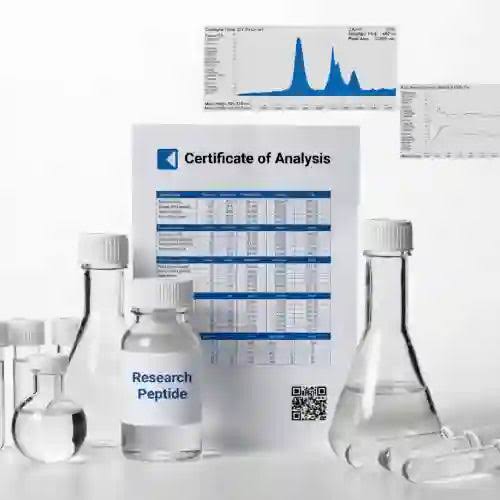
Knowing how to read a peptide COA is an important part of evaluating laboratory research materials. A Certificate of Analysis can provide researchers with information about a particular product or batch, but simply seeing a COA on a supplier’s website does not automatically tell you everything about the material.
Researchers should understand what the document contains, which analytical methods were used, whether the report corresponds to the relevant batch, and what conclusions can reasonably be drawn from the results.
This is especially important when comparing research peptide suppliers. Two products may both advertise high purity, yet the supporting documentation, testing methods and traceability can differ significantly.
This guide explains how to read a peptide COA, what HPLC and mass spectrometry can tell researchers, which details should be checked, and how analytical documentation fits into a broader research peptide quality assessment.
Research Use Only: Peptide World Lab products are intended strictly for laboratory and scientific research purposes. They are not intended for human consumption, self-administration, diagnosis, treatment or prevention of disease.
What Is a Peptide Certificate of Analysis?
A Certificate of Analysis, commonly abbreviated as COA, is a document containing analytical or quality information associated with a material.
For research peptides, a COA may contain information such as:
- Product or compound name
- Batch or lot number
- Testing date
- Purity result
- Analytical method
- Molecular information
- Laboratory information
- Storage information
- Test results
The exact format can differ between laboratories and suppliers.
Understanding how to read a peptide COA means examining each piece of information rather than looking only at the purity percentage.
Why Is a Peptide COA Important?
Research depends heavily on reproducibility.
If scientists conduct an experiment using a particular research material, they need confidence that they understand what material was actually used.
Analytical documentation can help researchers assess:
- Product identity
- Sample purity
- Batch traceability
- Testing methodology
- Material consistency
A peptide certificate of analysis can therefore form part of the documentation researchers use when evaluating laboratory materials.
However, it should not be considered in isolation.
Researchers should also examine product specifications, analytical reports, supplier information and the requirements of their particular experiment.
Check the Product Name First
The first thing to examine when learning how to read a peptide COA is the product identification.
The compound listed on the COA should correspond to the research material being evaluated.
This sounds obvious, but it is an important verification step.
Researchers should compare:
- Product name
- Compound name
- Product listing
- Available molecular information
- Supplier documentation
If there is uncertainty regarding the compound identity, researchers should seek clarification before relying on the documentation, research peptide purity
Check the Batch or Lot Number
The batch number is one of the most important details on a research peptide COA.
A supplier may produce or source the same research compound in multiple batches.
Analytical results from one batch should not automatically be assumed to describe every later batch.
When evaluating a COA, compare the batch or lot number on the documentation with the batch associated with the research product where this information is available.
Batch traceability helps researchers document precisely which material was used.
Why Batch-Specific Testing Matters
Imagine a laboratory material produced in several separate batches.
Even when manufacturing processes are consistent, researchers should not assume that every batch is analytically identical without appropriate evidence.
Batch-specific documentation can help provide information about the particular material being evaluated, research peptide purity.
This is why research peptide quality involves more than finding a generic test report somewhere on a supplier’s website.
Researchers should determine whether documentation relates to:
the current batch
rather than simply:
the same product name.
Check the Testing Date
Another useful field is the analytical testing date.
The date helps researchers understand when the reported analysis was performed.
When learning how to read a peptide COA, ask:
- When was the sample tested?
- Does the date correspond reasonably with the batch?
- Is the documentation current?
- Is there sufficient information to connect the report to the product?
A testing date alone does not determine quality, but it contributes to traceability.
Understanding Peptide Purity
Purity is often the first number researchers notice on a COA.
Research products may be advertised with values such as:
98% purity
or
99% purity
However, understanding research peptide purity requires knowing how that percentage was determined.
A purity result is meaningful only within the context of the analytical method used.
Researchers should therefore ask:
- Which method measured purity?
- What exactly was measured?
- Does the report show supporting analytical data?
- Is the result connected to the relevant batch?
Simply displaying a large percentage does not answer these questions, research peptide purity.
What Does 99% Peptide Purity Mean?
A statement of 99% purity generally indicates that an analytical method found the primary component to account for approximately that proportion according to the specific measurement conditions.
But researchers should avoid interpreting the number too broadly.
For example, chromatographic purity does not necessarily answer every question about:
- Molecular identity
- Water content
- Counterions
- Residual solvents
- Other characteristics of the material
The exact interpretation depends on the analytical procedure.
This is why researchers should understand the difference between purity and identity.
Peptide Purity vs Peptide Identity
This distinction is one of the most important parts of understanding how to read a peptide COA.
Purity
Purity generally concerns how much of the measured sample corresponds to the primary component relative to detected additional components under a particular analytical method.
Identity
Identity concerns whether the compound is actually the intended molecule.
These are related questions, but they are not identical, research peptide purity.
A laboratory can therefore use different analytical techniques to investigate different characteristics of the sample.
What Is HPLC Peptide Testing?
HPLC stands for High-Performance Liquid Chromatography.
It is commonly used in peptide analysis.
HPLC separates components within a sample according to their interactions with the chromatographic system.
Depending on the method, researchers can use chromatographic data to evaluate:
- Sample composition
- Relative purity
- Additional peaks
- Separation characteristics
HPLC peptide testing is therefore particularly useful for evaluating sample purity.
How to Read an HPLC Peptide Report
An HPLC report may contain a chromatogram displaying peaks.
The major peak generally represents the dominant component detected under the analytical conditions, peptide COA testing.
Smaller peaks may represent other components detected during analysis.
Researchers should examine:
- Number of peaks
- Relative peak areas
- Reported purity
- Sample information
- Testing method
- Batch information
Interpreting a chromatogram properly may require analytical expertise, especially when more detailed conclusions are needed.
Does HPLC Prove Peptide Identity?
Not necessarily by itself.
This is a common misunderstanding in research peptide marketing.
An HPLC result may provide valuable information about chromatographic purity, but researchers should avoid assuming that a high HPLC purity percentage automatically proves molecular identity.
This is why complementary analytical techniques can be important.
For researchers learning how to read a peptide COA, remember:
HPLC can provide important purity information, but purity and identity are different analytical questions.
What Is Mass Spectrometry?
Mass spectrometry is another analytical technique commonly used in molecular research, peptide COA testing.
It measures characteristics related to the mass-to-charge ratio of ions and can provide valuable information about molecular mass.
For peptide characterization, mass spectrometry may help researchers determine whether observed molecular information is consistent with the expected compound.
This makes peptide mass spectrometry particularly useful alongside chromatographic analysis.
HPLC vs Mass Spectrometry for Peptides
These techniques should not necessarily be viewed as competitors.
They answer different analytical questions.
HPLC
Can provide information about:
- Sample separation
- Relative purity
- Additional components
- Chromatographic profile
Mass Spectrometry
Can provide information associated with:
- Molecular mass
- Molecular characterization
- Compound identity support
Together, these techniques may provide a more complete analytical picture than relying on a single purity percentage.
Check Whether the Laboratory Is Identified
When reviewing analytical documentation, determine whether information about the testing laboratory is available.
Useful details may include:
- Laboratory name
- Testing date
- Report identifier
- Analytical method
- Sample identifier
The amount of information available can vary depending on the laboratory and report type.
Researchers should evaluate documentation based on the needs and standards of their own laboratory work.
Third-Party Testing vs Supplier Testing
Researchers may encounter both internal and independent analytical documentation, peptide certificate of analysis.
Independent or third-party testing means the analysis was performed by a laboratory separate from the supplier.
This separation can provide additional confidence in some circumstances.
However, researchers should still evaluate the actual documentation.
A “third-party tested” claim without accessible details should not automatically replace careful examination of:
- Batch information
- Testing method
- Product identity
- Analytical results
- Laboratory information
The quality of the evidence matters more than the marketing phrase.
Common Red Flags When Reviewing a Peptide COA
Knowing how to read a peptide COA also means knowing what deserves closer examination.
Potential concerns can include:
- Missing product identification
- No batch or lot number
- Documentation unrelated to the current batch
- No testing date
- Purity claims without an analytical method
- Difficult-to-read analytical results
- Inconsistent product information
- Missing traceability information
- Claims stronger than the analytical data supports
One missing field does not automatically establish that a material is unsuitable.
However, unexplained inconsistencies should encourage researchers to seek additional information.
Why COA Verification Matters for Research Reproducibility
Reproducibility is fundamental to scientific research.
If two laboratories conduct similar experiments but use materials with substantially different characteristics, their results may differ.
Research-material quality can therefore affect:
- Experimental consistency
- Data interpretation
- Reproducibility
- Cross-study comparisons
- Laboratory records
Understanding how to read a peptide COA can help researchers document the materials used in their experiments more carefully.
Peptide Storage Information on a COA
Some analytical or product documents may also contain storage guidance.
Peptide stability can be influenced by factors such as:
- Temperature
- Light
- Moisture
- Packaging
- Contamination
- Storage duration
Researchers should follow the storage requirements associated with the specific laboratory material.
A high-quality peptide can still become unsuitable for a particular experiment if handled or stored incorrectly, peptide certificate of analysis.
Is a COA Enough to Choose a Research Peptide Supplier?
A COA is useful, but it should not be the only criterion.
When evaluating research peptide quality, researchers should consider the broader supplier environment.
Useful factors include:
- Clear compound identification
- Analytical documentation
- Batch traceability
- Research-use labelling
- Transparent product information
- Storage guidance
- Secure checkout
- Shipping information
- Customer support
- Clear policies
A professional research supplier should make it reasonably easy for researchers to understand what they are purchasing, how to read a peptide COA.
Research Peptides USA – What Researchers Should Check
Researchers searching for research peptides USA may encounter dozens of suppliers advertising similar compounds.
Rather than comparing only price, researchers should examine documentation.
Before selecting laboratory materials, check:
- Product identity
- Purity information
- COA availability
- Batch details
- Analytical methods
- Storage requirements
- Research-use classification
- Supplier policies
This can help researchers make more informed procurement decisions.
How This Applies Across Different Research Peptides
The principles in this guide apply broadly across laboratory peptide research, how to read a peptide COA.
For example, Peptide World Lab has educational resources covering compounds such as:
- Cortagen
- Chonluten
- CJC-1295 No DAC / Mod GRF 1-29
- ARA-290
- Vilon
- Epithalamin
- MOTS-C
Rather than making this article compete with those product-specific pages, how to read a peptide COA addresses a completely different search intent.
A researcher can learn about analytical documentation here and then use that knowledge when evaluating an individual laboratory research product.
This is exactly the kind of informational-to-commercial pathway we want across the website.
Finding Reliable Analytical Information
Researchers can supplement supplier documentation with established scientific and regulatory resources.
The U.S. Food and Drug Administration provides extensive information about analytical methods, laboratory science and pharmaceutical quality principles.
For published biomedical literature, researchers can also use resources from the National Library of Medicine.
Independent scientific resources are particularly useful for understanding analytical terminology rather than relying exclusively on supplier marketing.
Research Use Only
Research peptides discussed by Peptide World Lab are intended strictly for laboratory and scientific research.
They are not intended for:
- Human consumption
- Self-administration
- Diagnosis
- Medical treatment
- Disease prevention
- Therapeutic use
Nothing in this guide should be interpreted as medical advice or human-use instructions.
Important Links:
👉 ARA-290 laboratory research guide
👉 CJC-1295 No DAC and Mod GRF 1-29 research guide
👉 Vilon peptide bioregulator research
Final Thoughts
Understanding how to read a peptide COA can help researchers evaluate laboratory materials more carefully.
Rather than looking only for a large purity percentage, researchers should examine the entire analytical context.
Important considerations include product identity, batch number, testing date, analytical method and supporting documentation.
HPLC can provide useful information regarding chromatographic purity, while mass spectrometry may contribute additional information concerning molecular characterization. These methods answer different analytical questions and should be interpreted accordingly.
Researchers should also determine whether analytical documentation corresponds to the actual batch of research material being evaluated.
Most importantly, a COA should form part of a broader quality assessment rather than becoming the only reason for selecting a research supplier.
By understanding analytical documentation, researchers can make better-informed decisions when comparing laboratory materials and maintain stronger records for experimental reproducibility.
Frequently Asked Questions
1. What is a peptide COA?
A peptide COA, or Certificate of Analysis, is a document that may contain information about a research material, including product identification, batch number, purity results, analytical methods and testing dates.
2. How do I read a peptide COA?
Start by checking the compound name, batch number and testing date. Then review the reported purity, analytical methods and any supporting HPLC or mass spectrometry information.
3. Does 99% HPLC purity prove peptide identity?
Not necessarily. HPLC can provide important chromatographic purity information, but purity and molecular identity are different analytical questions.
4. What is the difference between HPLC and mass spectrometry?
HPLC is commonly used to separate sample components and evaluate relative purity, while mass spectrometry provides molecular-mass information that can contribute to compound characterization.
5. Why should peptide COAs be batch-specific?
Different batches may have different analytical characteristics. Batch-specific documentation improves traceability and helps researchers connect analytical results with the actual material used in an experiment.